
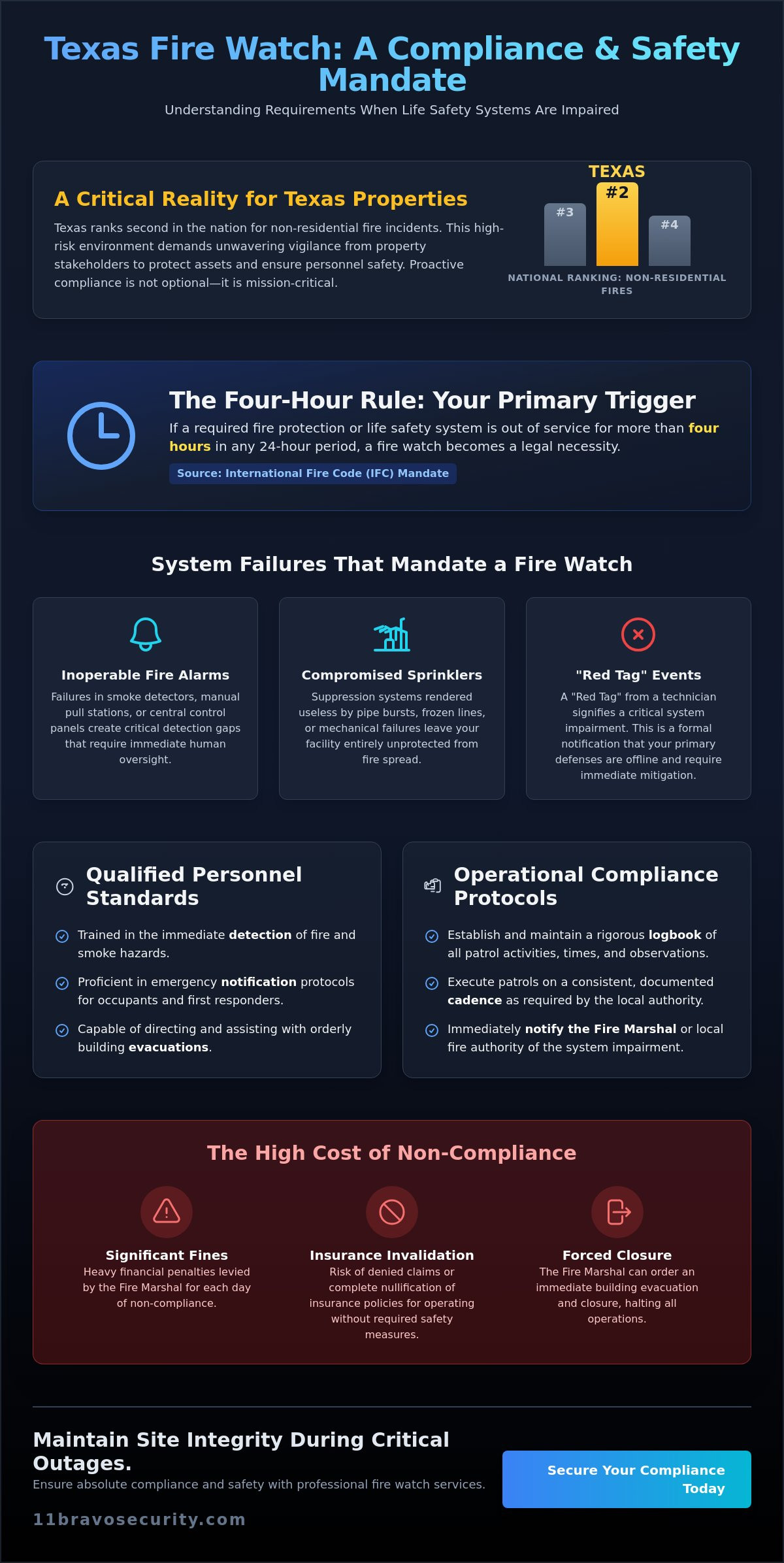
Texas ranks second in the nation for non-residential fire incidents. This reality demands unwavering vigilance from every property stakeholder. When a fire suppression system fails, the margin for error disappears. Understanding exactly when is a fire watch required in Texas is no longer just a regulatory hurdle; it’s a mission-critical requirement for site safety. You likely feel the pressure of avoiding catastrophic fines from the Fire Marshal or the risk of a denied insurance claim. Confusion between local amendments and national standards often leaves facility managers vulnerable to significant operational risk.
This 2026 compliance guide ensures you master the legal triggers, personnel standards, and operational protocols necessary to maintain absolute compliance. We provide a clear briefing on the 2024 International Fire Code, the definition of qualified personnel, and the documentation required to keep your doors open. Our focus remains on three pillars: protection, precision, and professional standards. By the end of this analysis, you’ll have a strategic roadmap to manage system impairments and ensure your facility remains a secure environment.
Key Takeaways
- Identify the specific legal window that triggers an immediate transition to manual fire surveillance.
- Master the criteria for when is a fire watch required in Texas under the latest 2024 International Fire Code and local marshal standards.
- Define the qualified personnel standard to ensure your site monitors are trained in detection, notification, and evacuation.
- Establish rigorous logbook protocols and patrol cadences to prevent building closures and insurance claim denials.
- Deploy veteran-led precision and rapid response to maintain site integrity during critical system outages.
Fire Watch Mandates: Navigating Texas Fire Code and IFC Standards
Texas ranks second in the nation for non-residential fire incidents. This high volume of risk demands a standard of vigilance that automated systems alone cannot provide. A fire watch is a proactive, human-monitored surveillance mission designed to detect early signs of fire before they escalate into a catastrophe. It serves as the primary line of defense when technical fire protection systems are compromised. Understanding when is a fire watch required in Texas is essential for any property owner aiming to maintain operational continuity. Failure to comply can lead to immediate building evacuations, forced closures, and the nullification of insurance policies. We prioritize three core values: integrity, discretion, and unwavering focus.
The legal foundation for fire safety in the state rests on the International Fire Code and the NFPA 101 Life Safety Code. While state law provides a baseline, local fire officials serve as the final authority on safety requirements. In cities like Irving, Dallas, and Fort Worth, local fire departments often enforce stricter requirements than the state minimums. We approach these mandates with the same rigor as a tactical briefing. Compliance is not a suggestion; it is a professional duty to protect lives and high-value assets.
The International Fire Code (IFC) Baseline
The IFC serves as the regulatory foundation for most Texas municipalities. Under these rules, a building owner must appoint a designated safety manager to oversee the facility when fire systems fail. If a fire protection system is out of service for more than four hours within a 24-hour window, a fire watch becomes a legal necessity. A “Red Tag” notice from a technician is a tactical signal that your primary defenses are down. We respond to these signals with disciplined oversight to ensure your site remains secure and compliant with all local ordinances.
NFPA 101 Life Safety Code Integration
NFPA 101 standards provide additional layers of protection, particularly for high-occupancy residential and healthcare facilities. Local fire officials prioritize these standards because they focus on life safety in complex, multi-tenant structures. The code distinguishes between planned maintenance and emergency outages. While maintenance is scheduled, an unexpected failure requires immediate deployment of qualified personnel. Our team understands these nuances and provides the professional presence required to satisfy the most demanding inspectors. Knowing when is a fire watch required in Texas allows you to act decisively when these safety standards are triggered.
Primary Triggers: When Your Life Safety Systems Fail or Impair
The threshold for action is clearly defined by state and local regulations. Under the International Fire Code, the “Four-Hour Rule” dictates that any system failure exceeding four hours within a 24-hour period requires a manual watch. This is a legal mandate that ensures your property remains protected when automated sensors are offline. Understanding when is a fire watch required in Texas starts with monitoring this specific clock. Once that window closes, your facility is technically out of compliance and subject to immediate enforcement action. We provide the human oversight needed to bridge this gap with professional precision.
Life safety systems are complex and can fail in both predictable and unpredictable ways. Inoperable fire alarms, including smoke detectors, pull stations, and control panels, create immediate blind spots in your defense. Mechanical malfunctions in sprinkler systems are equally critical. We have observed significant pipe bursts and frozen lines during recent Texas winter events that rendered entire systems useless. These failures leave your assets and occupants defenseless. We deploy mission-ready personnel to maintain safety until your technical defenses are restored.
System Malfunctions and “Red Tag” Events
Differentiating between a “trouble” light and a full system failure is a vital skill for property managers. A trouble light might indicate a minor battery issue, but a red tag indicates a total failure of a critical safety component. If your monitoring company reports a failure, you must act immediately. You are required to notify the local fire authority to remain in compliance. This ensures the fire marshal is aware of your mitigation efforts. If you need clarity on these reporting protocols, speak with our compliance experts.
Hot Work and Construction Site Hazards
High-heat operations represent a constant thermal threat to active job sites. Our approach to construction site security integrates fire watch as a core tactical component. Welding, cutting, and grinding are primary triggers for human surveillance. These activities require a dedicated “Post-Work Watch.” Guards must remain on-site for 30 to 60 minutes after work stops to detect smoldering embers. We adhere strictly to National Fire Protection Association (NFPA) standards to protect combustible materials in industrial settings. Vigilance is our standard; safety is our mission.
Personnel Requirements: The ‘Qualified’ Standard and Certification in Texas
Identifying when is a fire watch required in Texas is the first step in any compliance mission. The second is deploying personnel who meet the state’s rigorous definition of “qualified.” Many property owners mistakenly believe any staff member can fulfill this role. This is a dangerous assumption. Under Texas law, a watcher must possess specific competencies in fire detection, alarm notification, and evacuation procedures. We believe that a protector’s effectiveness is rooted in their training and moral character. Integrity is our foundation.
The Legal Definition of a Qualified Watcher
The Texas State Fire Marshal demands a specific set of tactical skills for anyone standing watch. These individuals must be proficient in operating fire extinguishers and manual pull stations. They’re required to maintain direct communication protocols with emergency dispatch. Their focus must be unwavering. In cities like Dallas, these individuals must be at least 21 years old and physically fit to manage an evacuation. We ensure our personnel exceed these baseline requirements through continuous operational training. We don’t settle for the minimum.
Professional Guards vs. Internal Staff
The “Sole Duty” Rule is a non-negotiable standard in fire safety. A person on watch cannot answer phones, clean facilities, or perform maintenance. Their only mission is surveillance. Using internal staff often creates liability gaps that lead to insurance claim denials. Professionals understand the different fire dynamics found in high-rise structures versus industrial warehouses. They bring a level of focus that untrained employees lack.
Choosing the right personnel is just as critical as knowing when is a fire watch required in Texas. Professional fire watch services shift this liability away from the property owner. We bring military-grade discipline to every assignment. Our team represents a standard of prestige and reliability. We provide safety, reassurance, and protection. This is about more than a patrol; it’s about a solemn duty to protect your assets.
Operational Compliance: Logbook Documentation and Patrol Protocols
Compliance is not a passive state. It is an active operational posture. Once you have determined when is a fire watch required in Texas, the focus shifts to tactical execution. Understanding the logistics behind when is a fire watch required in Texas is only half the battle; documenting that watch is what keeps you in the good graces of local fire officials. The Fire Watch Log serves as your primary defense during an inspection. It is a legal record of vigilance. We maintain these logs with precision to ensure no gaps in coverage exist. Any lapse in documentation is a lapse in safety. Our methodology is built on three pillars: integrity, precision, and discipline.
The mission requires a clear communication protocol. If a fire is detected, the guard must have the capability to notify the fire department and initiate building evacuation immediately. This is a solemn duty. We establish route planning that prioritizes high-threat zones. These areas include electrical rooms, server hubs, and commercial kitchens. Every patrol is a deliberate search for hazards. We remain vigilant so you don’t have to worry about building closures or insurance denials. We provide the reassurance that comes from being protected by experienced professionals.
Logbook Precision and Record Keeping
A compliant logbook requires specific data points to satisfy local fire marshal inspections. Every entry must include the exact time of the patrol, the specific areas inspected, and the guard’s signature. Inspectors in the North Texas area generally prefer physical logbooks maintained on-site for immediate review. We follow a “No Gaps” policy. This ensures 24/7 continuity until your systems are fully restored. If you are facing a system failure now, contact our tactical team for immediate deployment.
Tactical Patrol Execution
Our patrol cadence is determined by occupancy and risk levels. We mandate 15, 30, or 60-minute intervals based on the specific requirements of the local fire marshal. Guards are trained to identify early indicators of combustion like smell, haze, and localized heat. We also ensure fire exits and exit paths remain unobstructed at all times. For large-scale industrial sites, our mobile patrol services provide the dynamic coverage needed to maintain a secure perimeter. We protect your assets with unwavering focus.
Securing Your Perimeter: Tactical Fire Watch Solutions by 11 Bravo Security
Understanding when is a fire watch required in Texas is the first step in protecting your property. The second step is choosing a partner who views safety as a solemn duty. We bring military-grade discipline to every deployment. Our team consists of mission-ready guards who operate with a refined sense of purpose. We don’t just stand watch; we execute a tactical surveillance plan tailored to your facility’s specific vulnerabilities. Our commitment is summarized in three core values: Integrity, Discretion, and Reliability.
We recognize that an emergency outage or a failed inspection requires immediate action. Our rapid deployment protocols ensure that professional oversight is on-site before the legal window of non-compliance closes. We provide customized risk mitigation for commercial, industrial, and high-occupancy residential properties. Every assignment is treated as a high-stakes operation where failure is not an option. We protect your assets with the same precision we brought to our previous service in the armed forces.
Why 11 Bravo is the Preferred Choice in Irving
Our team possesses a deep knowledge of local North Texas fire codes and the specific expectations of the Authority Having Jurisdiction. We understand that “qualified personnel” must adhere to the “Sole Duty” rule without compromise. Beyond emergency response, we offer integration with our security consulting services DFW to help property owners identify long-term safety gaps. We are a localized guardian for the Irving and DFW business communities. We seek to be the primary source of truth for your security needs.
Initiating Your Defense
When you face a “Red Tag” emergency, you need more than a warm body in a uniform. You need a disciplined professional who can manage an evacuation and coordinate with emergency services. We provide comprehensive daily reporting to property owners. This ensures you have a verifiable paper trail for the Fire Marshal and your insurance provider. Don’t leave your compliance to chance. Knowing when is a fire watch required in Texas is your signal to call the professionals. Contact us today to secure your perimeter and maintain absolute site safety.
Maintaining Strategic Vigilance and Site Integrity
Mastering the triggers of the 2024 International Fire Code is a strategic necessity for every Texas building owner. We have established the critical importance of the “Four-Hour Rule” and the requirement for precise, human-monitored logbooks. Understanding when is a fire watch required in Texas allows you to transition from reactive anxiety to proactive site management. Compliance is a mission. It requires disciplined personnel who understand their sole duty is the protection of lives, property, and operational continuity. Our methodology ensures that your facility remains a safe and secure environment.
We provide a foundation of total reliability through our veteran-owned and operated team. Our personnel are specifically trained in IFC and NFPA 101 standards to ensure your facility remains open and your insurance coverage remains intact. We offer rapid emergency deployment across the DFW area to mitigate risk during critical system failures. Our approach is defined by three pillars: integrity, discretion, and unwavering reliability. You can trust our experienced professionals to maintain a secure perimeter under any conditions.
Secure Your Facility with Mission-Ready Fire Watch Services. We stand ready to protect your mission.
Frequently Asked Questions
How long can a fire alarm be down before a fire watch is required in Texas?
A fire watch is mandatory in Texas when a building’s fire alarm or sprinkler system is out of service for more than four hours in a 24-hour period. This standard is established by the International Fire Code. Individual cities often require a watch to begin immediately upon system failure. You should verify the specific timeline with your local Authority Having Jurisdiction to ensure absolute compliance. This proactive step prevents building closures and maintains site safety.
Can a regular security guard perform fire watch duties?
A security guard can only perform these duties if they meet the state’s “Qualified Personnel” standard and have no other responsibilities. Texas law requires watchers to be specifically trained in fire detection, alarm notification, and evacuation procedures. A guard cannot perform standard site security and fire watch at the same time. This “Sole Duty” rule ensures the watcher remains focused entirely on identifying thermal threats and protecting the facility.
What are the fire watch log requirements for Dallas and Irving?
Logbooks in Dallas and Irving must include the date, the exact time of each patrol, the guard’s name, and their signature. You must also document the specific areas inspected and any hazards or corrective actions taken. These records must be maintained on-site and ready for immediate review by the Fire Marshal. Maintaining a precise and continuous log is your primary defense against regulatory fines and building closures.
Do I need a fire watch for hot work if my sprinklers are working?
A fire watch is required for hot work even if your sprinkler systems are fully operational. Activities like welding, cutting, or grinding create immediate risks that automated systems might not detect in time to prevent significant damage. You must maintain a dedicated watcher during the operation and for at least 30 to 60 minutes after the work concludes to ensure no smoldering embers remain. This protocol protects your assets from thermal threats.
What happens if I get caught without a required fire watch?
Failure to deploy a watch when required can lead to severe consequences including immediate building closures and significant fines. Fire Marshals have the authority to issue “Red Tag” citations that halt all business operations until the risk is mitigated. Additionally, your insurance provider may deny claims related to fire damage if they determine you were out of compliance with state fire codes when the incident occurred. This risk is too great to ignore.
Is a fire watch required 24/7 or only during business hours?
A fire watch is required 24/7 as long as the fire protection system is impaired and the building remains occupied. The risk of fire does not disappear when business hours end. You must maintain continuous surveillance through nights, weekends, and holidays until the system is fully restored and approved by the local fire department. This ensures a constant state of readiness and protection for all occupants throughout the impairment period.
How do I notify the Fire Marshal that I have started a fire watch?
You must contact your local fire marshal’s office or the non-emergency dispatch line to report the system impairment and the start of your watch. Provide your building address, the nature of the system failure, and the contact information for your qualified personnel. This transparency is a key part of understanding when is a fire watch required in Texas and demonstrates your commitment to professional safety standards. It also ensures proper coordination with emergency services.
Does insurance cover the cost of fire watch services?
Most property insurance policies don’t directly reimburse the cost of fire watch services, but they often require them as a condition of coverage. If a fire occurs while your systems are down and you failed to provide a watch, your insurer may refuse to pay for the damages. Investing in professional surveillance is a strategic choice to protect your long-term financial interests and ensure your claims remain valid. This is a standard part of risk management.